

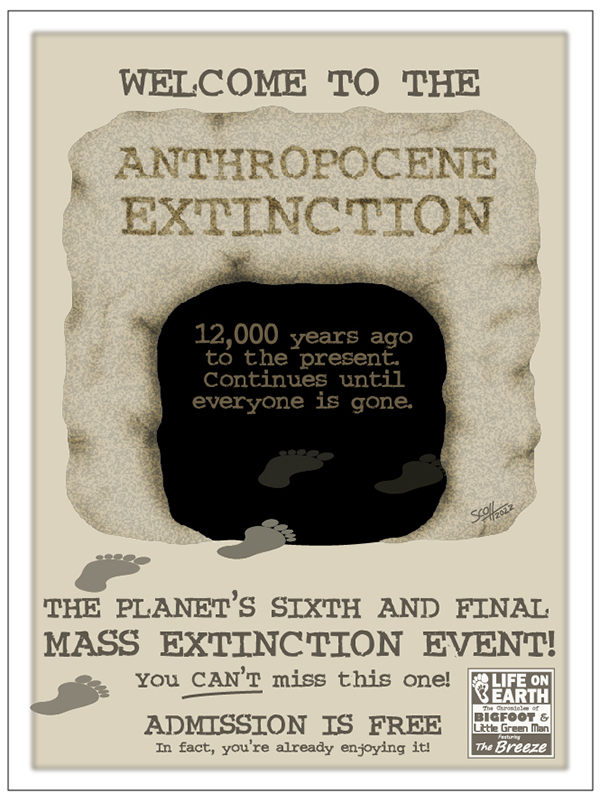
Welcome to the Holocene Extinction—1800 to Present…and
beyond. How long and how bad is up to you.
A little history.
Earth has hosted many extinctions since life began here 3 and a half billion
years ago. Extinctions occur when environments change faster than organisms
can adapt. While we don’t fully understand the all forces driving them,
scientists list 6 major extinction events as evidenced by the fossil record.
The first one, 450 Million years ago (Mya) was the Ordovician-Silurian Extinction.
85% of all marine species perished. There were not yet any animals living
on land.
Then came the Late Devonian Extinction 370 Mya. This event may have lasted
20 million years! By the time of this event, the land had been colonized by
plants and insects.
The big one, the Permian-Triassic, followed that 250 Mya, wiping out more
than 90% of Earth’s species. Included in this loss were some of the
largest insects ever to have existed. It was history's
biggest loss of insect species, and biggest loss overall.
The Triassic-Jurassic Extinction, 201 Mya, came next, after which the dinosaurs
came into dominance.
Number 5 was the last big one, 66 million years ago, the one that killed the
dinosaurs and allowed the mammals to dominate.
Number 6? We’re in it. The Holocene Extinction, also known as the Anthropocene
Extinction, because we are the cause of it, started about 13,000 years ago
with increased human activities. It only really became an unstoppable force
about 200 years ago, in the industrial age. We don’t know how long it
will last, but this is the only one that we know for certain the cause: human
activity.
The same creatures that the dinosaurs’ demise allowed to flourish are
now the cause of the current extinction. So keep in mind, the downfall of
the dinosaur is the only reason we are here, and ironically we became the
cause of our own extinction. And most likely we are taking nearly everyone
else with us.
Humans are ill-suited, woefully unprepared, and largely unwilling to make
the effort to survive.
Scientists have been warning us of this for at least 60 years. It’s
past time to pay attention. For you optimists, yes, the planet itself will
survive. And very likely, some organisms will survive. But the mammals, birds,
reptiles, amphibians, most fish, most plants, and of course, humans, will
all become extinct. The increasingly harsh conditions we are currently experiencing
are just the tip of the melting iceberg. Our last days will NOT be comfortable.
Perhaps the remaining lower organisms will adapt to the new conditions, and
eventually evolve into new species. And perhaps, in 3 or 4 billion years,
there may be a new intelligent species.
And perhaps, just perhaps, the members of that new species will be good stewards
for their home. Earth deserves much better. We took too much, and gave back
too little. Mother earth provided bountiful riches, which were squandered,
sold to the highest bidder.
It may not be too late to salvage the planet, but it will take a massive effort
and much sacrifice from everyone.
© 2022 Scott Wright


